

How do you fix your sleep schedule? Start with the alarm.
In motion data from 60,977 adults, the regularity of sleep predicted mortality better than its length. What that means for your alarm, and what an all-nighter really does.
Eight hours in bed, and at 07:00 you still feel as if you had slept five. In a 30-day study of 61 undergraduates, sleepiness peaked at 06:33 for the least regular sleepers and at 04:45 for the most regular (Phillips et al., 2017). A 07:00 alarm catches the first group less than half an hour after their sleepiest point. The largest study of the question found that the regularity of a sleep schedule predicted mortality better than its length (Windred et al., 2024).
What does a regular sleep rhythm do?
Your body clock runs on a cycle of roughly one day and needs resetting every day, mostly by light (Phillips et al., 2017). Regularity is what lets it settle.
The strongest evidence comes from the UK Biobank. In 2024 Daniel Windred and his colleagues worked through more than ten million hours of motion-sensor data from 60,977 participants with an average age of about 63, and scored for each person how closely one day's sleep and wake times matched the next (Windred et al., 2024). Over the following six years or so, people in the four more regular fifths had a 20 to 48 per cent lower risk of dying from any cause than the least regular fifth, and regularity turned out to be a stronger predictor than how long people slept. Duration still counts, and the guide to how much sleep you need shows how to find your own number.
20–48%
lower risk of death from any cause among the more regular sleepers, 60,977 adults (Windred et al., 2024)
The analysis allowed for age, sex, lifestyle and health, but it remains an observation and does not prove cause. The authors put it carefully themselves: regularity may be a simple, effective target for improving general health and survival (Windred et al., 2024).
The student study shows what this looks like in ordinary life. Andrew Phillips and his colleagues had 61 undergraduates keep sleep diaries for 30 days, and the least regular ones had body clocks running about two and a half hours later than the most regular (Phillips et al., 2017). The researchers' model put most of that difference down to light, because the irregular sleepers lived with a much flatter daily light rhythm, 102 lux against 179 for the regular group.
Strength of the daily light rhythm, 61 students over 30 days. Regular sleepers: 179lux; Irregular sleepers: 102lux.
Source: Phillips et al., 2017
The more regular students also tended to get better grades (Phillips et al., 2017).
Should you pull an all-nighter to reset it?
It sounds efficient. Skip one night and you will be tired enough to fall asleep early the next evening, and for that one evening it is true.
For your rhythm, though, an all-nighter is the least regular night there is. In 2023 a panel of the US National Sleep Foundation, with Tracey Sletten as first author, reviewed 63 publications on sleep timing (Sletten et al., 2023). Its experts reached consensus that consistent times for falling asleep and waking up matter for health, safety and performance. They also agreed that catching up at weekends may help when weekday sleep falls short. A lost night only adds to that shortfall, and afterwards the clock sits wherever your light puts it (Phillips et al., 2017). What that shortfall costs is covered under sleep deprivation effects.
How to fix a sleep schedule, one alarm at a time
The nine:thirty protocol calls this the sleep window, a fixed frame for falling asleep and waking up that holds at weekends too. It starts with the alarm, because the wake-up time is the one fixed point you fully control. Which lights-out window fits your wake-up time is what the sleep calculator works out.
Get up at the same time every day, weekends included, within about a quarter of an hour. A steady morning makes a steady evening much easier.
Get daylight early. If a flat light rhythm pushes the clock later, as the student study suggests (Phillips et al., 2017), a few minutes outdoors before you look at your phone is the simplest counterweight.
Give the evening an ending. A sleep routine that finishes the same way each night, with the last screen off at a set time, protects the new schedule. Why the evening feed is so hard to put down is covered in the guide to doomscrolling, and why the phone is better charged outside the bedroom in its own article. If it is your thoughts rather than the phone that keep going, the guide to stopping overthinking at night starts at the same hour. And if you keep waking up at 3am despite a steady schedule, a separate guide explains what happens in those hours and what to do. The guides to sleep cycles and how to get more deep sleep look inside the night itself.
07:00, Saturdays included. You can catch up on sleep at the weekend, partly. You cannot catch up on regularity.
Frequently asked questions
What is the best sleep schedule?
The one you can keep on all seven days. There is no single right bedtime for everyone, but the evidence clearly favours regularity. In 60,977 UK adults, a steadier pattern of sleep and wake times predicted mortality better than sleep duration did (Windred et al., 2024). Pick times you can also hold at weekends, and let the alarm anchor them.
Can you fix your sleep schedule in one day?
Not reliably. An all-nighter makes you tired enough to fall asleep early once, but it is the least regular night you can have, the opposite of what a 2023 expert panel recommends (Sletten et al., 2023). A fixed wake-up time every day and daylight in the morning are the steadier route, even if they take longer.
How do you fix your sleep schedule for school?
Start with the alarm, not the bedtime. In a 30-day study of 61 undergraduates, students with more regular sleep tended to get better grades, and the least regular had body clocks running later (Phillips et al., 2017). Keep the same wake-up time at weekends, get outside in the morning and let your bedtime settle around it.
Sources
- Phillips, A. J. K., Clerx, W. M., O’Brien, C. S., Sano, A., Barger, L. K., Picard, R. W., Lockley, S. W., Klerman, E. B., & Czeisler, C. A. (2017). Irregular sleep/wake patterns are associated with poorer academic performance and delayed circadian and sleep/wake timing. Scientific Reports, 7(1), Article 3216. https://doi.org/10.1038/s41598-017-03171-4
- Sletten, T. L., Weaver, M. D., Foster, R. G., Gozal, D., Klerman, E. B., Rajaratnam, S. M. W., Roenneberg, T., Takahashi, J. S., Turek, F. W., Vitiello, M. V., Young, M. W., & Czeisler, C. A. (2023). The importance of sleep regularity: A consensus statement of the National Sleep Foundation sleep timing and variability panel. Sleep Health, 9(6), 801–820. https://doi.org/10.1016/j.sleh.2023.07.016
- Windred, D. P., Burns, A. C., Lane, J. M., Saxena, R., Rutter, M. K., Cain, S. W., & Phillips, A. J. K. (2024). Sleep regularity is a stronger predictor of mortality risk than sleep duration: A prospective cohort study. Sleep, 47(1), Article zsad253. https://doi.org/10.1093/sleep/zsad253
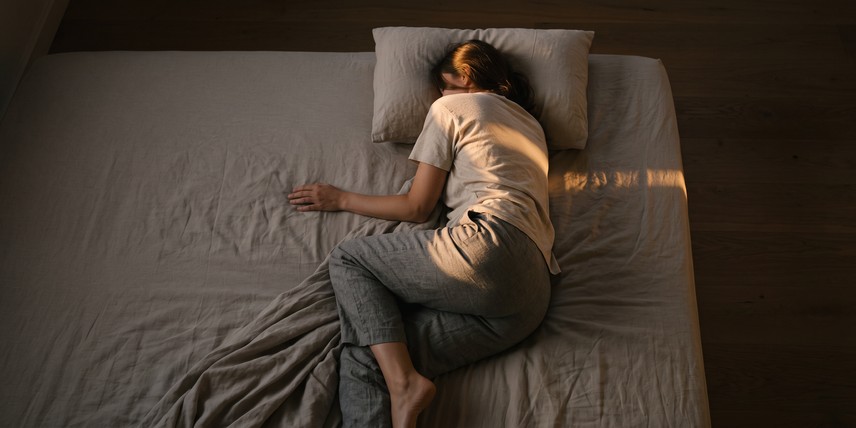
Is there a best sleep position? Not one for everybody.
Measured at home, adults spend just over half their time in bed on their side, about a third on their back and very little on their front, and they change position 1.6 times an hour. No study has found one best position for everyone, but there are three situations where it counts.
Is sleeping with the window open better? Ask the street.
In Danish bedrooms an open window brought overnight carbon dioxide down by more than half, and people slept longer. A tilted window also lets in the street, only about 15 dB quieter. Here is what the measurements found for air, door and noise, and how to decide tonight.
Does the full moon affect sleep, or does your evening light?
Before a full moon, sleep starts later and runs shorter, by minutes rather than hours. Wrist sensors put the shortest nights 3 to 5 days before the full moon, and the reason sits in the early evening, where your own lamp outshines the moon.
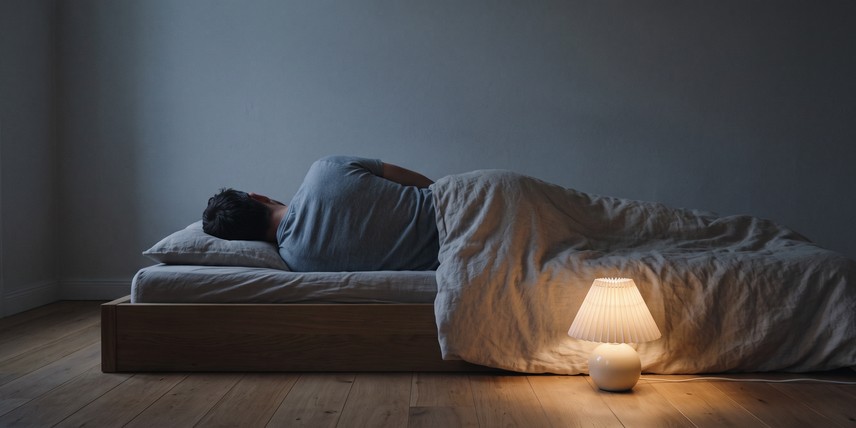
Sleeping with the lights on? Your heart notices.
Ten young adults slept one night under 100 lux of ceiling light, and their hearts beat faster all night without them noticing. What the study shows, what the big cohorts add, and how dark your bedroom should be tonight.
How to get more deep sleep? Stop spending it first.
Every list online gives the same advice: keep it cool, exercise, skip the wine, try pink noise. The studies rank it differently. One evening workout added 1.3 percentage points of deep sleep, and the most marketed lever added no minutes at all in the laboratory.

Sleep cycles vary too much for a 90-minute alarm.
An analysis of 6064 cycles recorded in a sleep laboratory found a range of 60 to 150 minutes for 95 per cent of the values, and the first cycle was the shortest. For your alarm that means the clock time matters more than the cycle.
Is 6 hours of sleep enough if you feel fine?
In a two-week lab study, 6 hours a night left healthy adults as impaired as a night without any sleep. Their own sense of sleepiness barely moved after the first days.
Of all the sleep hygiene rules, three have the evidence.
The usual lists have ten to fifteen rules, all presented as equally important. A 2015 review found little direct evidence for most of them, while three rules are well measured, including the one about coffee whose cost you cannot feel.
Sleep deprivation starts costing you after a single night.
After 17 to 19 hours without sleep, people scored on some tests as badly as at a 0.05% blood alcohol level. Over years the bill shows up in diabetes and mortality, and there the regularity of your nights counts too.

How to fall asleep fast? Start before the lights go out.
41 per cent of adults in Germany fall asleep within ten minutes, and one in seven needs more than half an hour. The famous 60-second tricks were never tested on sleep onset, but a to-do list was.

How much sleep do I need? Two weeks without an alarm.
Seven to nine hours is the advice, which leaves a two-hour gap every night. In a Tokyo sleep lab, young men’s own need averaged 8.41 hours, more than an hour above what they slept at home, and none of them had noticed.

Waking up at 3am is common. Lying awake needn’t be.
In a survey of 8,937 adults, more than a third woke up at least three nights a week. What happens in those hours, and why watching the clock keeps you awake.