

Sleep deprivation starts costing you after a single night.
After 17 to 19 hours without sleep, people scored on some tests as badly as at a 0.05% blood alcohol level. Over years the bill shows up in diabetes and mortality, and there the regularity of your nights counts too.
00:50. You have been awake since 06:10, twenty minutes of driving lie ahead, and you feel tired but perfectly fine. This is where sleep deprivation starts to show. In an Australian lab study of 39 people, 17 to 19 hours without sleep left performance on some tests as poor as it was at a blood alcohol concentration of 0.05%, and on some tests worse (Williamson & Feyer, 2000). That is the legal limit for most drivers in Germany.
From there the costs build in stages that researchers can measure: after one night, after a week of short nights, and over years. The longest stage holds a finding most sleep advice leaves out, which is that the regularity of your nights counts as well as their length.
What happens after one night of sleep deprivation?
The Australian volunteers were 30 transport workers and nine members of the army. They stayed awake for 28 hours straight and, on other days, drank measured doses of alcohol, so that the same tests could compare the two states (Williamson & Feyer, 2000). The 17 to 19 hours fell at 22:30 and 01:00 on the clock, and after longer still without sleep their scores reached the level of the highest alcohol dose, about 0.1%. Seventeen hours awake is not an extreme. It is a day that starts at six and ends just before midnight.
A second group led by Nicole Lamond and Drew Dawson found much the same in 1999. They kept 22 young adults awake for 28 hours and, in a separate session, had them drink until they reached 0.10% (Lamond & Dawson, 1999). Depending on the task, roughly 20 to 25 hours awake produced the same decline. These were computer tests in a lab, not drives on a road, but they point one way.
Emotions tip quickly too. In 2007 a team led by Seung-Schik Yoo and Matthew Walker kept 14 young adults awake for about 35 hours while 12 others slept as usual (Yoo et al., 2007). In the brain scanner, the amygdala, a region involved in processing emotion, reacted 60 per cent more strongly to unpleasant pictures in the sleep-deprived group, and the area that lit up was three times larger. Its link to a region of the prefrontal cortex that normally puts such reactions in context was weaker. That was one night without sleep, measured in a scanner rather than in daily life.
How often such hours end at the wheel is harder to pin down. In a survey of 12,434 drivers in 19 European countries, 17 per cent said they had fallen asleep while driving in the previous two years, and 17.1 per cent of the respondents from Germany said the same (Gonçalves et al., 2015). The most common reason they gave, at 42.5 per cent, was poor sleep the night before. The team led by Marta Gonçalves points out that the online sample was self-selected and not representative.
Sleep deprivation symptoms you don’t feel
Some symptoms announce themselves. In the 2017 sleep survey by the German health insurer Techniker Krankenkasse, 60 per cent of adults said they woke up rested and refreshed, but among people sleeping six hours or less it was only one in two (TK, 2017). A midday nap appealed to 35 per cent of those short sleepers and to 22 per cent of people getting seven to eight hours.
Other effects stay silent. In 1999 Karine Spiegel, Rachel Leproult and Eve Van Cauter gave 11 healthy young men only four hours in bed for six nights in a row (Spiegel et al., 1999). Afterwards the men cleared sugar from their blood nearly 40 per cent more slowly than after recovery sleep. Their insulin response to the sugar was 30 per cent lower, and the clearance rate fell below the value the authors describe as typical of older adults with impaired glucose tolerance. The comparison was with nights of 12 hours in bed rather than with normal sleep, and the group was small.
The immune system seems to notice as well. Aric Prather and his colleagues had 164 healthy adults wear a movement sensor on the wrist for a week in 2015, then gave them nose drops containing a cold virus (Prather et al., 2015). Those who had averaged less than six hours a night that week were considerably more likely to develop a cold than those who slept more than seven. The estimate is uncertain, since the comparison group had only 22 people, and the sleep people recorded in their own diaries did not predict who fell ill. In the TK survey, 11 per cent of people who slept poorly said they often had colds, against 7 per cent of good sleepers, though the survey cannot say which causes which (TK, 2017).
What chronic sleep deprivation does over years
Years of short sleep cannot be produced in a lab, so the evidence here comes from large cohort studies. In 2017 Osamu Itani and his colleagues pooled 153 of them, covering 5,172,710 people followed for at least a year (Itani et al., 2017). Short sleepers had a 12 per cent higher risk of death over follow-up than people who slept a normal length, a 37 per cent higher risk of diabetes and a 38 per cent higher risk of obesity.
How much higher the risk was with short sleep, 153 cohort studies. Obesity: 38%; Diabetes: 37%; Coronary heart disease: 26%; High blood pressure: 17%; Cardiovascular disease: 16%; Death: 12%.
Source: Itani et al., 2017
The risk was 26 per cent higher for coronary heart disease, 17 per cent for high blood pressure and 16 per cent for cardiovascular disease overall (Itani et al., 2017). Below six hours, mortality climbed further with each hour lost, while the other outcomes showed no such gradient. These are observational studies, so they cannot show whether short sleep is the cause or a sign of something else.
The surprise came in 2024. Daniel Windred, Andrew Phillips and their colleagues analysed more than 10 million hours of wrist-sensor data from 60,977 people in the UK Biobank, who wore the device for a week and were then followed for an average of 6.3 years (Windred et al., 2024). The most regular fifth went to sleep and woke up within a window of about one hour on most days, the least regular within about three hours. Over the follow-up, the most regular sleepers had a 30 per cent lower risk of death than the least regular. That figure is already adjusted for age, physical activity, smoking, social circumstances, shift work and more, and regularity predicted the risk of death better than sleep duration did.
The authors are clear about the limits. It is an association, based on a single week of data, in a mostly older and almost entirely white population (Windred et al., 2024). For deaths from cardiometabolic causes, duration was the stronger factor once both were in the fully adjusted model. Rhythm does not replace hours of sleep. It adds to them.
A US study by Tianyi Huang and Susan Redline points the same way. Among older adults, every hour of night-to-night variation in sleep duration came with 27 per cent higher odds of metabolic syndrome, the cluster of belly fat, high blood pressure, unfavourable blood fats and raised blood sugar (Huang & Redline, 2019). Over the following six years or so, an hour of variation in bedtime came with 36 per cent higher odds of developing it, a result the authors themselves call only marginally significant. How to steady your own rhythm is covered in the guide to your sleep schedule. What a fixed schedule does for heart rate variability, and what it does not, is in how to improve heart rate variability.
How long does it take to recover from sleep deprivation?
Longer than one long night. In 2010 Siobhan Banks and David Dinges restricted 142 adults to four hours in bed for five nights, then randomly assigned each of them a single recovery night of between zero and ten hours (Banks et al., 2010). Even ten hours in bed did not bring attention, sleepiness and fatigue back to baseline, and the authors suggest that full recovery may need a longer night or several nights.
A Japanese team led by Shingo Kitamura and Kazuo Mishima measured how deep an everyday deficit runs. Fifteen healthy young men spent nine nights in a row in the lab with 12 hours in bed (Kitamura et al., 2016). At home, they had been sleeping about an hour a night less than their bodies took when given the chance, and it was the fourth night before their sleep settled at that natural length. The authors estimate that up to nine days of sufficient sleep may be needed to clear such a debt, and blood sugar and hormone measures improved as it cleared. The same approach, done at home, is how our guide works out how much sleep you need.
The nine:thirty protocol answers with a sleep window, a fixed frame for going to sleep and waking up that holds at the weekend too. Count back from the alarm rather than in 90-minute blocks: sleep cycles vary too much for a calculator to hit them.
Keep your wake-up time within a one-hour window on all seven days, which is how tightly the most regular sleepers in the UK study lived (Windred et al., 2024). A week of writing down two times a day, lights out and getting up, shows you where you stand. If they spread wider than an hour, rhythm is the place to start. If you sleep enough hours and still cannot get up, how to get out of bed in the morning helps you tell the three usual causes apart. After a short week, catch up with several normal nights rather than one very long one, as the recovery studies suggest (Banks et al., 2010). What two weeks of short nights do is covered in the guide to whether 6 hours of sleep is enough, and if sleep will not come in the evening, the guide on how to fall asleep fast picks up from there, while waking up at 3am and lying awake is a different problem with its own fixes.
Do not drive after more than 17 hours awake, however alert you feel (Williamson & Feyer, 2000). And if you keep nodding off during the day for weeks despite a fixed window, keep one rule in mind. If this lasts longer than four weeks, it belongs with a doctor, not in an article.
07:00 alarm, Saturdays included, and no driving after 17 hours awake. The rhythm only costs you your Saturday lie-in.
Frequently asked questions
How long can you go without sleep?
Research gives no fixed limit. A 1966 medical paper described a person who stayed awake for 264 hours, eleven days in a row (Gulevich et al., 1966). The danger starts much earlier, since after 17 to 19 hours without sleep, performance on some tests already matched a blood alcohol level of 0.05% (Williamson & Feyer, 2000).
How long does it take to recover from sleep deprivation?
Usually more than one night. After five nights of four hours in bed, even ten hours of recovery sleep did not bring attention and sleepiness back to baseline (Banks et al., 2010). In young men carrying about an hour of nightly sleep debt, sleep only settled at its natural length after four nights with long sleep opportunities (Kitamura et al., 2016).
Is 4 hours of sleep enough?
Not as a regular pattern. After six nights of four hours in bed, healthy young men cleared sugar from their blood nearly 40 per cent more slowly than after recovery sleep (Spiegel et al., 1999). After five such nights, even one ten-hour night of recovery could not fully restore attention (Banks et al., 2010).
Sources
- Banks, S., Van Dongen, H. P. A., Maislin, G., & Dinges, D. F. (2010). Neurobehavioral dynamics following chronic sleep restriction: Dose-response effects of one night for recovery. Sleep, 33(8), 1013–1026. https://doi.org/10.1093/sleep/33.8.1013
- Gonçalves, M., Amici, R., Lucas, R., Åkerstedt, T., Cirignotta, F., Horne, J., Léger, D., McNicholas, W. T., Partinen, M., Téran-Santos, J., Peigneux, P., Grote, L., & National Representatives as Study Collaborators. (2015). Sleepiness at the wheel across Europe: A survey of 19 countries. Journal of Sleep Research, 24(3), 242–253. https://doi.org/10.1111/jsr.12267
- Gulevich, G., Dement, W., & Johnson, L. (1966). Psychiatric and EEG observations on a case of prolonged (264 hours) wakefulness. Archives of General Psychiatry, 15(1), 29–35. https://doi.org/10.1001/archpsyc.1966.01730130031005
- Huang, T., & Redline, S. (2019). Cross-sectional and prospective associations of actigraphy-assessed sleep regularity with metabolic abnormalities: The Multi-Ethnic Study of Atherosclerosis. Diabetes Care, 42(8), 1422–1429. https://doi.org/10.2337/dc19-0596
- Itani, O., Jike, M., Watanabe, N., & Kaneita, Y. (2017). Short sleep duration and health outcomes: A systematic review, meta-analysis, and meta-regression. Sleep Medicine, 32, 246–256. https://doi.org/10.1016/j.sleep.2016.08.006
- Kitamura, S., Katayose, Y., Nakazaki, K., Motomura, Y., Oba, K., Katsunuma, R., Terasawa, Y., Enomoto, M., Moriguchi, Y., Hida, A., & Mishima, K. (2016). Estimating individual optimal sleep duration and potential sleep debt. Scientific Reports, 6, Article 35812. https://doi.org/10.1038/srep35812
- Lamond, N., & Dawson, D. (1999). Quantifying the performance impairment associated with fatigue. Journal of Sleep Research, 8(4), 255–262. https://doi.org/10.1046/j.1365-2869.1999.00167.x
- Prather, A. A., Janicki-Deverts, D., Hall, M. H., & Cohen, S. (2015). Behaviorally assessed sleep and susceptibility to the common cold. Sleep, 38(9), 1353–1359. https://doi.org/10.5665/sleep.4968
- Spiegel, K., Leproult, R., & Van Cauter, E. (1999). Impact of sleep debt on metabolic and endocrine function. The Lancet, 354(9188), 1435–1439. https://doi.org/10.1016/S0140-6736(99)01376-8
- Techniker Krankenkasse [TK]. (2017). Schlaf gut, Deutschland: TK-Schlafstudie 2017. https://www.tk.de/resource/blob/2033604/118707bfcdd95b0b1ccdaf06b30226ea/schlaf-gut-deutschland-data.pdf
- Williamson, A. M., & Feyer, A.-M. (2000). Moderate sleep deprivation produces impairments in cognitive and motor performance equivalent to legally prescribed levels of alcohol intoxication. Occupational and Environmental Medicine, 57(10), 649–655. https://doi.org/10.1136/oem.57.10.649
- Windred, D. P., Burns, A. C., Lane, J. M., Saxena, R., Rutter, M. K., Cain, S. W., & Phillips, A. J. K. (2024). Sleep regularity is a stronger predictor of mortality risk than sleep duration: A prospective cohort study. Sleep, 47(1), Article zsad253. https://doi.org/10.1093/sleep/zsad253
- Yoo, S.-S., Gujar, N., Hu, P., Jolesz, F. A., & Walker, M. P. (2007). The human emotional brain without sleep – a prefrontal amygdala disconnect. Current Biology, 17(20), R877–R878. https://doi.org/10.1016/j.cub.2007.08.007
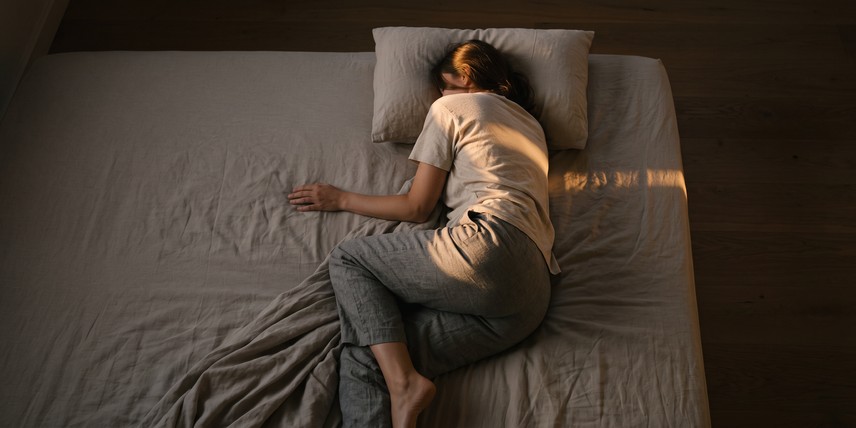
Is there a best sleep position? Not one for everybody.
Measured at home, adults spend just over half their time in bed on their side, about a third on their back and very little on their front, and they change position 1.6 times an hour. No study has found one best position for everyone, but there are three situations where it counts.
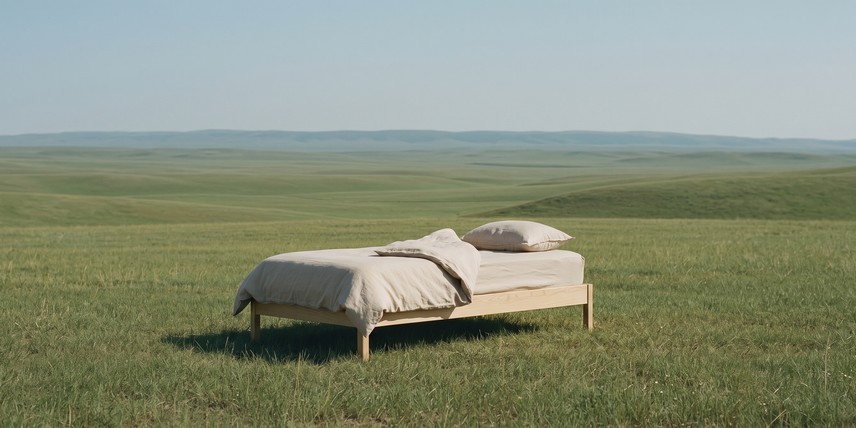
Is sleeping with the window open better? Ask the street.
In Danish bedrooms an open window brought overnight carbon dioxide down by more than half, and people slept longer. A tilted window also lets in the street, only about 15 dB quieter. Here is what the measurements found for air, door and noise, and how to decide tonight.
Does the full moon affect sleep, or does your evening light?
Before a full moon, sleep starts later and runs shorter, by minutes rather than hours. Wrist sensors put the shortest nights 3 to 5 days before the full moon, and the reason sits in the early evening, where your own lamp outshines the moon.