

How to stop overthinking at night without fighting it.
Thought-stopping, the most common advice, has never been tested on sleep, and suppressing a worry made the night look worse in a study of 60 people. Two things have better data: a detailed scene in your head, and a five-minute to-do list before lights out.
It is 23:10, the lights have been off for twenty minutes, and you are rehearsing tomorrow's difficult email for the third time. Most advice on how to stop overthinking tells you to shut it down: say "stop", snap a rubber band, count five things you can see. In 2003 the psychologist Allison Harvey tested the principle behind that advice. People asked to push their main worry out of mind before sleep judged that they took longer to fall asleep, and slept worse, than people told to let thoughts come and go (Harvey, 2003). Fighting racing thoughts at night feeds them. What helps is giving the mind a different job.
Why do thoughts race when the light goes out?
During the day every thought competes with conversations, messages and errands. In a dark bedroom the competition disappears, and whatever stayed unfinished gets the whole stage. Researchers call this pre-sleep cognitive arousal, and it shows up in measurements, not only in how the night feels. Peggy Zoccola and her colleagues had 70 people give a five-minute speech to an evaluating panel one afternoon (Zoccola et al., 2009). The more someone tended to ruminate, the longer they took to fall asleep that night, as measured by a wrist sensor, while their total sleep time did not change.
It is worth being honest about the size of this. Pooling 55 studies of people from the general population, more worry and rumination went with a longer time to fall asleep, but the association was small (Clancy et al., 2020). Plenty of busy-headed nights end in perfectly ordinary sleep. In Germany, 29 percent of adults say work stress often costs them sleep, and the same share name private or family problems, according to the 2017 sleep study by the health insurer TK (TK, 2017). The single most common complaint in that survey was not the mind at all: 41 percent said a room that was too warm or too cold kept them awake, which is why we wrote a separate piece on the best temperature for sleep.
Why telling your brain to stop makes it louder
Harvey's study had 60 participants, half of them with insomnia and half good sleepers (Harvey, 2003). Each picked the thought most likely to occupy them at bedtime, and was then randomly told either to suppress it or to leave their thoughts alone. Suppression made the night look worse in both groups. The limitation matters a great deal: these were the participants' own estimates, not lab recordings, and the minutes sit behind a paywall we could not get past. An older experiment from 1996 adds a twist. People told to fall asleep as fast as possible took longer, but only while they listened to rousing marches; with calm music, the same instruction helped (Ansfield et al., 1996). Pressure on an already busy mind is the problem, not the wish to sleep.
For the rubber band and the 5-4-3-2-1 exercise we found no study that measured sleep at all. They come from anxiety and habit work, and may be useful there.
| Method | Best used | What a study measured |
|---|---|---|
| Pushing the thought away | in bed | longer estimated time to fall asleep, 60 participants (Harvey, 2003) |
| Picturing a detailed scene | in bed | faster sleep than with no instructions, 41 participants (Harvey & Payne, 2002) |
| Five-minute to-do list | just before lights out | 15.82 instead of 25.09 minutes to fall asleep (Scullin et al., 2018) |
| Writing down solutions | earlier in the evening | less mental arousal before sleep, 33 participants (Carney & Waters, 2006) |
| Fixed worry time | once a day, 30 minutes | no better sleep in 186 participants (McCarrick et al., 2025) |
How to stop worrying in bed, and what to do earlier
Start in bed, because that is where the problem shows up. A team led by Allison Harvey gave 41 people with insomnia one of three instructions for a single night (Harvey & Payne, 2002). Those asked to imagine an engaging, detailed scene fell asleep faster and had fewer distressing thoughts than those given no instructions; a vague "distract yourself" did not bring the same benefit. The authors put it down to "cognitive space": a rich scene leaves too little room for the worry to come back. Pick a scene you know in detail, such as the walk from your front door to the bakery, step by step, with the sounds and smells. If you would rather stay with your own body, a body scan meditation for sleep applies the same idea from the toes to the forehead. If you would rather count than picture things, 4-7-8 breathing gives you fixed counts to hold on to.
Then move the real content out of bed. Michael Scullin's team at Baylor University asked 57 healthy young adults to write for five minutes before a night in the sleep lab (Scullin et al., 2018). Those who wrote a specific to-do list for the coming days fell asleep after 15.82 minutes on average, while those who wrote about tasks already done took 25.09 minutes, and the longer the list, the quicker the sleep. It was one night, in people without sleep problems, compared against a different writing task rather than no writing. Our evening routine shows where the list sits in the hours before bed.
Scheduled worry time, the other favourite of advice columns, has a mixed record. In 53 heavy worriers, a daily 30-minute worry period in a fixed place reduced worry and insomnia symptoms more than a comparison condition over two weeks (McGowan & Behar, 2013). A newer, larger trial with 186 participants found no improvement in falling asleep, night waking or sleep quality after 14 days (McCarrick et al., 2025). Writing down possible solutions to each worry, sometimes called constructive worry, lowered mental arousal before sleep over five nights in 33 students with sleep complaints, though the published summary does not say whether they fell asleep faster (Carney & Waters, 2006). Our reading is unglamorous, and we hold it for a reason: the only option with a sleep-lab measurement is the bedside list, so that is the one we put in the protocol, with solutions on paper earlier and a scene instead of a brake once the light is off. If you are still comparing tricks, the ways to fall asleep fast are lined up side by side.
If this lasts longer than four weeks, it belongs with a doctor, not in an article.
If the thoughts are mostly about your job, they can be handed over earlier still, with one sentence per open task at the end of the working day, as described in how to switch off from work. A different kind of evening writing is tested in the article on the gratitude journal. If the restlessness sits more in your body than in your head, progressive muscle relaxation for sleep starts there instead, and it takes a few weeks of practice.
In the nine:thirty protocol, writing belongs to the wind-down, not to the pillow, because a mind that has already handed over its list has less to manage in the dark.
22:30, a slip of paper by the bed, three things for tomorrow. The rest can wait until morning. It was planning to anyway.
Frequently asked questions
How do I fall asleep when my mind won't stop?
Give it a task instead of a brake. In a study of 41 people, those who pictured a detailed scene, such as a familiar walk step by step, fell asleep faster than those given no instructions (Harvey & Payne, 2002). People who actively pushed thoughts away rated their night worse (Harvey, 2003). Anything that belongs to tomorrow goes on paper before the light goes out.
Why do my thoughts race at night?
In a dark room nothing competes with them. After a stressful afternoon task, people who tended to ruminate took longer to fall asleep that night on a wrist sensor, without sleeping less overall (Zoccola et al., 2009). Across 55 studies the link between worry and slower sleep was real but small (Clancy et al., 2020), so a busy head does not have to mean a bad night.
Does scheduled worry time help sleep?
The evidence is mixed. In 53 heavy worriers, a daily 30-minute worry period cut worry and insomnia symptoms more than a comparison condition over two weeks (McGowan & Behar, 2013). A larger trial with 186 people found no better sleep after 14 days (McCarrick et al., 2025). Keep it if you like it, but for sleep the bedside to-do list has the stronger data.
Sources
- Ansfield, M. E., Wegner, D. M., & Bowser, R. (1996). Ironic effects of sleep urgency. Behaviour Research and Therapy, 34(7), 523–531. https://doi.org/10.1016/0005-7967(96)00031-9
- Carney, C. E., & Waters, W. F. (2006). Effects of a structured problem-solving procedure on pre-sleep cognitive arousal in college students with insomnia. Behavioral Sleep Medicine, 4(1), 13–28. https://doi.org/10.1207/s15402010bsm0401_2
- Clancy, F., Prestwich, A., Caperon, L., Tsipa, A., & O'Connor, D. B. (2020). The association between worry and rumination with sleep in non-clinical populations: A systematic review and meta-analysis. Health Psychology Review, 14(4), 427–448. https://doi.org/10.1080/17437199.2019.1700819
- Harvey, A. G. (2003). The attempted suppression of presleep cognitive activity in insomnia. Cognitive Therapy and Research, 27(6), 593–602. https://doi.org/10.1023/A:1026322310019
- Harvey, A. G., & Payne, S. (2002). The management of unwanted pre-sleep thoughts in insomnia: Distraction with imagery versus general distraction. Behaviour Research and Therapy, 40(3), 267–277. https://doi.org/10.1016/S0005-7967(01)00012-2
- McCarrick, D., Prestwich, A., Ferguson, E., & O'Connor, D. B. (2025). Effects of worry postponement on daily worry and sleep: A randomised controlled trial. Psychology & Health. Advance online publication. https://doi.org/10.1080/08870446.2025.2590072
- McGowan, S. K., & Behar, E. (2013). A preliminary investigation of stimulus control training for worry: Effects on anxiety and insomnia. Behavior Modification, 37(1), 90–112. https://doi.org/10.1177/0145445512455661
- Scullin, M. K., Krueger, M. L., Ballard, H. K., Pruett, N., & Bliwise, D. L. (2018). The effects of bedtime writing on difficulty falling asleep: A polysomnographic study comparing to-do lists and completed activity lists. Journal of Experimental Psychology: General, 147(1), 139–146. https://doi.org/10.1037/xge0000374
- Techniker Krankenkasse [TK]. (2017). Schlaf gut, Deutschland: TK-Schlafstudie 2017. https://www.tk.de/resource/blob/2033604/118707bfcdd95b0b1ccdaf06b30226ea/schlaf-gut-deutschland-data.pdf
- Zoccola, P. M., Dickerson, S. S., & Lam, S. (2009). Rumination predicts longer sleep onset latency after an acute psychosocial stressor. Psychosomatic Medicine, 71(7), 771–775. https://doi.org/10.1097/PSY.0b013e3181ae58e8
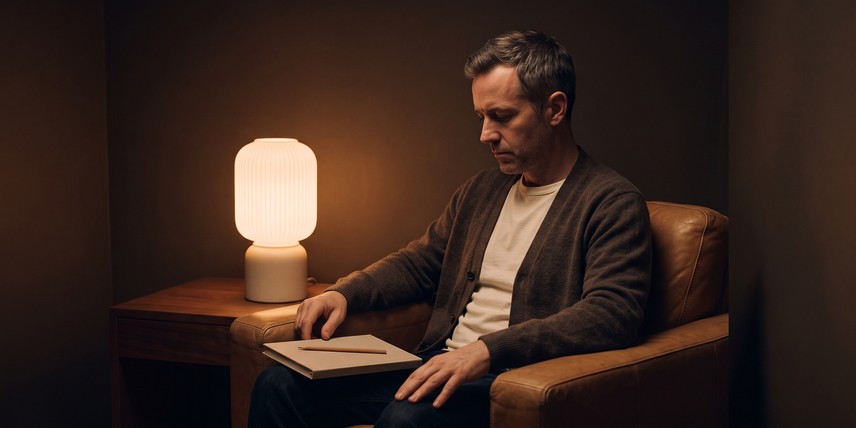
A gratitude journal needs five minutes, not a new notebook.
Up to five things in about five minutes each evening: that was the exercise in the studies, and 65 adults afterwards reported 7.58 instead of 7.06 hours of sleep. Against other exercises gratitude did no better, and how often to write is more open than the notebooks suggest.
How to switch off from work before the evening starts.
Unfinished tasks follow you home until they have a plan, and in one experiment a plan cut their intrusions from 3.00 to 1.77. The work does not have to be done, only scheduled, and that takes three minutes at 17:25.

Eating before bed costs your stomach more than your sleep.
A dinner one hour before bed left 20 people's sleep unchanged in the lab and pushed their blood sugar peak 18 per cent higher. The famous three hours come from reflux research, where they have a real reason.