

Of all the sleep hygiene rules, three have the evidence.
The usual lists have ten to fifteen rules, all presented as equally important. A 2015 review found little direct evidence for most of them, while three rules are well measured, including the one about coffee whose cost you cannot feel.
In 2013 Christopher Drake and colleagues in Detroit gave healthy adults a strong dose of caffeine six hours before bed, and a headband monitor recorded more than an hour of lost sleep (Drake et al., 2013). The same people's sleep diaries showed no reliable loss at all. That one finding explains a lot about sleep hygiene. The usual lists run to ten, twelve or fifteen rules, all presented as equally important, and the evidence behind them is anything but equal. Three are well measured. Several are plausible and barely tested, and at least one has been tested and found wanting.
What is sleep hygiene?
Sleep hygiene is a set of everyday habits and bedroom conditions meant to support good sleep: caffeine, alcohol, exercise, noise, naps, regular times and so on. As a package it performs surprisingly poorly. A 2018 meta-analysis of 15 studies led by Ka-Fai Chung found that sleep hygiene education did clearly worse than CBT-I, a structured behavioural programme for sleep problems, and that only self-reported measures improved at all (Chung et al., 2018).
That is why the American Academy of Sleep Medicine, in its 2021 guideline, advises against relying on sleep hygiene alone for chronic insomnia (Edinger et al., 2021). It does recommend one single rule on its own, stimulus control, on the strength of eight studies of low quality. More on that below. If this lasts longer than four weeks, it belongs with a doctor, not in an article.
The most careful look at the individual rules comes from Leah Irish and colleagues in 2015. Taking caffeine, nicotine, alcohol, exercise, stress, noise, regular timing and napping one at a time, they found every rule plausible, yet little direct evidence that following it improves sleep in the general population (Irish et al., 2015). Some rules fared worse than others: the evidence does not support the claim that late-night exercise disturbs sleep, and the ban on naps rests on very little research.
Screens get their own asterisk. In a well-known lab study, people who read on a tablet for 4 hours in the evening took nearly 10 minutes longer to fall asleep than with a printed book, and slept no less in total (Chang et al., 2015). The case for keeping the phone out of the bedroom is mostly about behaviour, and we cover it in the phone section, with the gap to keep between phone and sleep in screen time before bed. How to lock the apps on the device in the evening is in the Screen Time setup for iPhone.
A sleep hygiene checklist with three lines
| Rule | What was measured | Verdict |
|---|---|---|
| Fixed wake-up time | Irregular schedules are clearly linked to poorer sleep (Irish et al., 2015) | keep |
| Coffee by 14:00 | A normal cup needs an estimated 8.8 hours before bed (Gardiner et al., 2023) | keep |
| Bed for sleep only | Recommended on its own for chronic sleep problems (Edinger et al., 2021) | keep |
| No alcohol in the evening | Less REM sleep from about two drinks (Gardiner et al., 2025) | sensible |
| No screens before bed | 4 hours of tablet reading, nearly 10 minutes longer to fall asleep (Chang et al., 2015) | small effect |
| No naps | Little research supports the rule (Irish et al., 2015) | open |
| No evening exercise | The evidence does not support the rule (Irish et al., 2015) | drop |
First, fix the time you get up, not the time you go to bed. Irish and colleagues say plainly that bedtime regularity should not be a general recommendation, because the programmes sleep medicine relies on fix only the wake time and send you to bed once you are sleepy (Irish et al., 2015). Getting up at the same time every morning gives the body clock an anchor, and the evening can follow from it.
Second, stop caffeine in the early afternoon. Carissa Gardiner and colleagues pooled 24 studies in 2023: caffeine cut total sleep by 45 minutes on average and added 9 minutes to the time it took to fall asleep (Gardiner et al., 2023). For a normal cup of coffee, 107 milligrams, they estimated a gap of at least 8.8 hours before bed. If you want to sleep at 23:00, a last coffee at 14:00 leaves you just inside that margin.
Third, keep the bed for sleep. Sleep medicine calls this stimulus control: no working, worrying or scrolling in bed, and if you lie awake and it starts to annoy you, get up, go to another room and come back only when you feel sleepy again (Edinger et al., 2021). It sounds strict. It is also the only rule on the list recommended as a measure in its own right, and our piece on waking up at 3am shows what it looks like in the middle of the night. One caveat: that recommendation is based on people with long-standing sleep problems, not good sleepers.
Caffeine and sleep: the rule you can't feel breaking
Drake's study was small, which is exactly why its detail matters. Twelve healthy adults aged 19 to 48 took a pill at home on four evenings, either a placebo or 400 milligrams of caffeine, close to four times a normal cup (Gardiner et al., 2023), at bedtime, three hours before or six hours before (Drake et al., 2013). On placebo they slept 7.68 hours. With caffeine at bedtime they slept 6.60 hours, three hours before 6.54 hours and even six hours before only 6.50 hours.
Sleep after 400 mg of caffeine, measured. Placebo: 7.68hours; Caffeine at bedtime: 6.60hours; Caffeine 3 hours before: 6.54hours; Caffeine 6 hours before: 6.50hours.
Source: Drake et al., 2013
Their diaries told a milder story, just 41 minutes less sleep after the six-hour dose, and that difference was not statistically reliable (Drake et al., 2013). The authors suspect this gap is one reason people ignore caffeine advice: the loss the monitor records is a loss they do not feel. The study tested one high dose as a pill and nothing beyond six hours, so it cannot say where the safe line lies. The meta-analysis gives that line, and even there the 8.8 hours is a calculation rather than an experiment (Gardiner et al., 2023).
How to improve sleep hygiene in the first week
- 07:00
Get up, Saturdays included
The fixed wake time is the anchor the evening follows.
- 14:00
Last coffee of the day
A normal cup needs an estimated 8.8 hours before sleep.
- Evening
Go to bed only once you are sleepy
The bed stays a place for sleep, not for waiting.
- Night
If you lie awake and it annoys you, get up and go to another room
Back to bed only when sleepiness returns.
Start with the wake time alone. Add the other two rules once getting up at 07:00 holds on all seven days. When a night goes wrong, say after a late party, get up at your usual time anyway and go to bed that evening only when you are sleepy; the pressure that builds through the day does more than a lie-in until noon.
How many hours your window needs is what the two-week test in how much sleep do I need measures, and our guide to your sleep schedule explains why timing counts for more than hours. For lying awake at the start of the night, see how to fall asleep fast.
In the nine:thirty app these are two items in the daily protocol: the caffeine cut-off at 14:00 with its reminder, and the sleep window in the evening.
Up at 07:00, last coffee at 14:00, bed for the night only. The other nine rules fit on the back of the note.
Frequently asked questions
How long before bed should you stop drinking caffeine?
A meta-analysis of 24 studies estimated that a normal cup of coffee, 107 milligrams, should come at least 8.8 hours before bed (Gardiner et al., 2023). If you sleep at 23:00, that means a last coffee around 14:00. In a small study, a high dose six hours before bed still cost more than an hour of measured sleep (Drake et al., 2013).
Does alcohol help you sleep?
It can help you fall asleep, but the second half of the night becomes lighter and more broken once the alcohol is metabolised (Irish et al., 2015). A 2025 meta-analysis found REM sleep reduced from about two drinks, with the effect growing as the dose rises (Gardiner et al., 2025). A nightcap trades a faster start for a worse finish.
What is stimulus control?
Five instructions from sleep medicine: go to bed only when sleepy, get up when you cannot sleep, use the bed only for sleep and sex, get up at the same time every morning, and avoid daytime naps (Edinger et al., 2021). The American Academy of Sleep Medicine recommends it on its own for chronic sleep problems, based on eight low-quality studies.
Sources
- Chang, A.-M., Aeschbach, D., Duffy, J. F., & Czeisler, C. A. (2015). Evening use of light-emitting eReaders negatively affects sleep, circadian timing, and next-morning alertness. Proceedings of the National Academy of Sciences, 112(4), 1232–1237. https://doi.org/10.1073/pnas.1418490112
- Chung, K.-F., Lee, C.-T., Yeung, W.-F., Chan, M.-S., Chung, E. W.-Y., & Lin, W.-L. (2018). Sleep hygiene education as a treatment of insomnia: A systematic review and meta-analysis. Family Practice, 35(4), 365–375. https://doi.org/10.1093/fampra/cmx122
- Drake, C., Roehrs, T., Shambroom, J., & Roth, T. (2013). Caffeine effects on sleep taken 0, 3, or 6 hours before going to bed. Journal of Clinical Sleep Medicine, 9(11), 1195–1200. https://doi.org/10.5664/jcsm.3170
- Edinger, J. D., Arnedt, J. T., Bertisch, S. M., Carney, C. E., Harrington, J. J., Lichstein, K. L., Sateia, M. J., Troxel, W. M., Zhou, E. S., Kazmi, U., Heald, J. L., & Martin, J. L. (2021). Behavioral and psychological treatments for chronic insomnia disorder in adults: An American Academy of Sleep Medicine clinical practice guideline. Journal of Clinical Sleep Medicine, 17(2), 255–262. https://doi.org/10.5664/jcsm.8986
- Gardiner, C., Weakley, J., Burke, L. M., Roach, G. D., Sargent, C., Maniar, N., Huynh, M., Miller, D. J., Townshend, A., & Halson, S. L. (2025). The effect of alcohol on subsequent sleep in healthy adults: A systematic review and meta-analysis. Sleep Medicine Reviews, 80, Article 102030. https://doi.org/10.1016/j.smrv.2024.102030
- Gardiner, C., Weakley, J., Burke, L. M., Roach, G. D., Sargent, C., Maniar, N., Townshend, A., & Halson, S. L. (2023). The effect of caffeine on subsequent sleep: A systematic review and meta-analysis. Sleep Medicine Reviews, 69, Article 101764. https://doi.org/10.1016/j.smrv.2023.101764
- Irish, L. A., Kline, C. E., Gunn, H. E., Buysse, D. J., & Hall, M. H. (2015). The role of sleep hygiene in promoting public health: A review of empirical evidence. Sleep Medicine Reviews, 22, 23–36. https://doi.org/10.1016/j.smrv.2014.10.001
- Techniker Krankenkasse [TK]. (2017). Schlaf gut, Deutschland: TK-Schlafstudie 2017. https://www.tk.de/resource/blob/2033604/118707bfcdd95b0b1ccdaf06b30226ea/schlaf-gut-deutschland-data.pdf
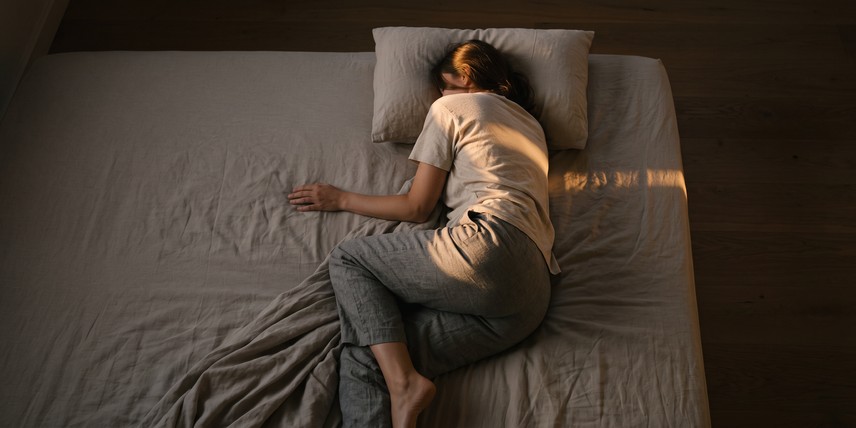
Is there a best sleep position? Not one for everybody.
Measured at home, adults spend just over half their time in bed on their side, about a third on their back and very little on their front, and they change position 1.6 times an hour. No study has found one best position for everyone, but there are three situations where it counts.
Is sleeping with the window open better? Ask the street.
In Danish bedrooms an open window brought overnight carbon dioxide down by more than half, and people slept longer. A tilted window also lets in the street, only about 15 dB quieter. Here is what the measurements found for air, door and noise, and how to decide tonight.
Does the full moon affect sleep, or does your evening light?
Before a full moon, sleep starts later and runs shorter, by minutes rather than hours. Wrist sensors put the shortest nights 3 to 5 days before the full moon, and the reason sits in the early evening, where your own lamp outshines the moon.